
Formula
Benchmarks
Calculator
Sell-through rate in fashion: formula and benchmarks
Sell-through rate is the share of the units you bought for a season that sold at full price within that season. Put in your own number to see where it sits against 21 mid-market fashion brands on Hakio.
Takes about a minute. Your number stays in your browser, and you see the result without giving us an email.
How to calculate sell-through rate
Annie Gisslen, VP of Customer Solutions at Hakio, calls sell-through "one of the clearest verdicts on whether you bought the right things in the right quantities." The guide measures it on units sold at planned price within the season.
Sell-through rate = units sold at full price within the season ÷ units bought for the season × 100
A brand that bought 10,000 units for the season and sold 6,500 of them at full price has a sell-through rate of 65%.
What good looks like
The benchmarks are split by portfolio, because NooS and seasonal product sell differently. NooS (Never-out-of-Stock) product is replenished continuously and sells year on year, while seasonal ranges are trend-led with short selling windows, which makes them harder to forecast and harder to clear.
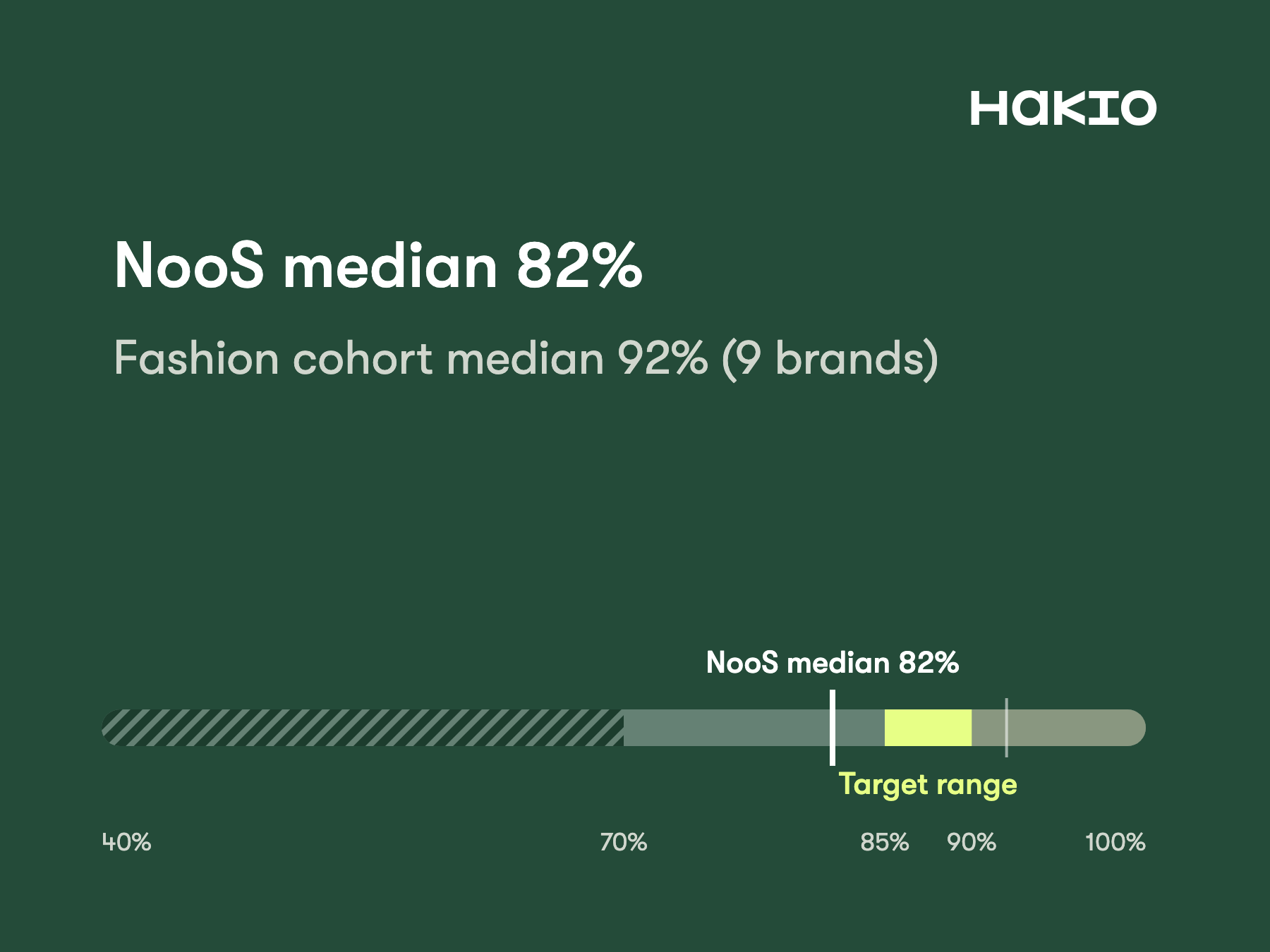
- NooS median in the Hakio base: 82%
- Fashion cohort median (9 brands): 92%. The cohort skews to stronger performers, so read it together with the NooS median.
- Industry target for mid-market fashion: 85 to 90%
- Below 70%: markdown at scale becomes unavoidable
Why 65% can be fine or a problem
When Annie starts working with a brand, the first conversation is about the targets and where the brand is today, and her example of that conversation starts with sell-through.
"Someone pulls their sell-through number and it says 65%, and the first question to ask is: is that good? As a consultant, I would say it depends. Basic brands running 65% most likely have a problem. A fashion-forward brand with a wide seasonal range hitting 65% could actually be OK."
What decides the verdict is category, season and price architecture, so a sell-through figure tells you little until you know which portfolio it comes from. Few teams have that reference point. In Hakio's June 2026 masterclass, more than three quarters of the audience said they don't benchmark their KPIs against any external data.
"Numbers by themselves are pretty meaningless, so you really need to have a reference point and a context in order to make sure that you're reacting to a clear signal."
Full price and net of returns
Two brands can both hit 80% sell-through, one at full price and one after 40% off, and end the season with very different margins. The benchmark therefore counts only product sold at planned price, and sell-through is best read next to markdown rate. As Annie puts it, "sell-through tells you what you sold, markdown tells you at what cost." Published industry figures put the margin lost to end-of-season discounting at 10 to 20% of gross margin.
Returns pull the other way and make gross sell-through look better than the business behind it. A brand with 85% gross sell-through and a 25% return rate has a net sell-through closer to 64%, and the gap between the two is also the signal to check GMROI.
Net sell-through = gross sell-through × (1 - return rate)
"It is very important to understand your return rate. It is very important to understand your net sell-through rates."
Below 70%, it's a buying problem
Annie draws the line at 70%.
"Some brands in the base sit below 70%, and that's really the line below which markdown at scale becomes unavoidable. At that point, it's not really a trading problem, it's a buying problem that shows up late in the process."
Low sell-through shows up in the trading reports, but when the cause is the buy, trading can only manage the symptom. For seasonal items, Annie is specific about where the fix sits:
"If your sell-through is below 70% for seasonal items, that's almost always a pre-season buying decision, and the fix is really in your next buy cycle."
Before you change anything, ask whether you are looking at a data-quality issue or a planning-process issue, because the two need very different fixes. In Annie's experience it is usually the second.
"In many cases it is unfortunately not a data issue, it is a planning and a process issue."
The guide reads sell-through below 70% together with markdown above 20% of gross margin as overbuying, the wrong mix or a price-architecture failure. The first moves it recommends are these:
- Audit the OTB split: how much of the buy was committed pre-season and how much was left flexible?
- Segment sell-through by category: breadth and depth ranges need different benchmarks.
- Run a markdown simulation before you act: understand the GMROI impact first.
The OTB split comes first: brands that leave a flexible reserve in their buy consistently outperform on sell-through, even when forecast accuracy is a little off, because they can still react to what's actually selling.
The benchmarks come from Hakio's guide Operating KPIs in Fashion and the quotes from the masterclass Stop guessing. Start planning with the right numbers, where Annie went through the numbers. Watch the masterclass. The guide and the recording are both free, with no form to fill in.
Book a planning review
This guide gave you the room's numbers. Now see your own. Bring them to a 30-minute review with a Hakio planning specialist.
You get a tailored benchmark report: where your brand sits on every metric in this guide, and where the gap to top performers is biggest.
Book a planning reviewFrequently asked questions
01
What is a good sell-through rate in fashion?
The industry target for mid-market fashion is 85 to 90%. In the Hakio base of 21 mid-market fashion brands, the NooS median is 82% and the fashion cohort median is 92%. Below 70%, markdown at scale becomes unavoidable.
02
How do you calculate sell-through rate?
Divide the units sold at full price within the season by the units bought for the season and multiply by 100. To see it net of returns, multiply the result by (1 - return rate).
03
Why can sell-through look strong while margin is weak?
Sell-through counts the units you sold, not the price they sold at. Two brands can both hit 80%, one at full price and one after 40% off, so read it with markdown rate and return rate.
Benchmarks: Operating KPIs in Fashion, Hakio benchmark guide, 2026. Anonymised and aggregated across 21 mid-market fashion brands on Hakio (16 to 19 brands per metric where the sample is narrower), supported by published industry sources (NRF 2025, McKinsey State of Fashion, IBF) where a metric is not yet measured in the platform. Quotes are from the June 2026 masterclass Stop guessing. Start planning with the right numbers.